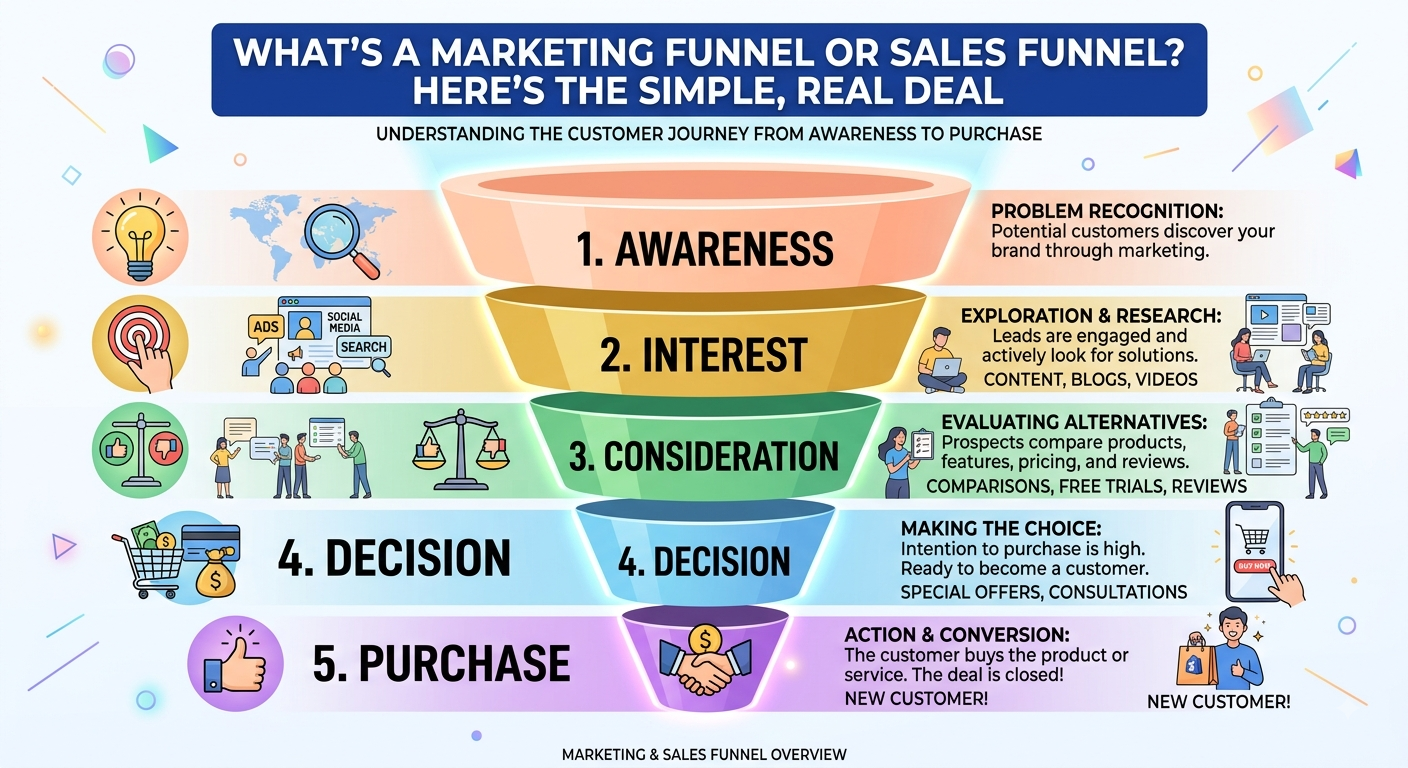
Let’s be honest almost nobody stumbles onto a business and buys right away. Usually, people spot your post on social media, maybe poke around your website, size you up against competitors, read a review or two, ask questions, and only then decide if they’re in or out. All those little steps they add up. That whole journey, from first noticing you to finally opening their wallet, is what marketers call a marketing or sales funnel.
Why does any of this matter? Because if you want more customers, you’ve got to know where they’re coming in and where you’re losing them.
So, What’s a Marketing Funnel?
Think of a marketing funnel as the big-picture roadmap. It shows each step a potential customer takes before they actually buy. Picture a real funnel: lots pour in at the top, but only a few trickle out the bottom and become customers.
Like, say:
- 1,000 people see your ad
- 300 visit your site
- 100 poke around for a bit
- 40 actually reach out
- 20 get a quote
- 8 buy
The numbers are always different, but what matters is what’s happening between each stage. That’s where you learn.
And the Sales Funnel?
Sales funnels zoom in on the steps that turn an interested person into a paying customer. If you run a service business, your funnel might look like this:
New Lead → Contacted → Qualified → Quoted → Negotiation → Won/Lost
Selling stuff online? It’s often shorter:
Product Discovery → Product Page → Cart → Checkout → Purchase
The steps really depend on how your customers make choices.
Marketing Funnel vs. Sales Funnel What’s the Big Difference?
People use these terms interchangeably, but here’s the quick breakdown:
- Marketing gets people in the door and warms them up.
- Sales actually closes the deal and brings in the money.
You need both firing together. Marketing creates interest; sales turns that interest into customers.
The Big 5 Stages of a Funnel
Stage 1: Awareness “Oh, You Exist?”
This is where folks first find you. They could stumble on you through Google, Instagram, Facebook, YouTube, ads, blogs, referrals you get the idea. They’re probably not ready to buy yet. Maybe they’re just looking for information or trying to solve a problem.
Like, someone Googles “website development services.” Bam they land on your page. At this point, you just want to get noticed.
Goal: Get on their radar.
Stage 2: Interest “Let’s See What You’ve Got”
Now, a chunk of people want to know more. Maybe they read your stuff, check out your services, watch a video, or scroll through your Instagram. Their thinking shifts from “Who’s this?” to “Can you actually help me?”
Here’s where you give them useful content. Don’t just yell “Buy Now!”help them understand their problem and show them how you’re the one with the solution.
Goal: Get them interested.
Stage 3: Consideration “Why Pick You?”
Now it gets serious. People start comparing. They look at your price, quality, reviews, credentials, portfolio, features whatever matters to them.
Trust is key here. Sure, you can say you’re the best, but real testimonials, case studies, or client stories go a lot further. Your job? Make them think, “You know what, I trust these folks. They deliver.”
Goal: Build trust and answer “Why you?”
Stage 4: Conversion “Let’s Do This”
The prospect’s ready to act. They might call you, fill out a form, book a call, ask for a quote, or just buy.
Don’t make this step a headache. Confusing forms, slow replies, or no follow-up? That’s how you lose people. Make the next step obvious “Get a Free Quote” or “Start Your Trial” clear beats generic every time.
Goal: Make buying (or reaching out) a breeze.
Stage 5: Retention “I’ll Stick Around”
The customer journey doesn’t end after one sale. Happy customers can come back, rave about you online, refer friends, or buy more services.
This is where good service and regular follow-ups turn a one-time sale into steady business.
Goal: Keep them coming back and telling others.
Why Is Any of This Important?
A lot of businesses chase more and more leads, thinking that’s the answer. But more leads don’t always mean more sales.
Picture this: You get 200 enquiries a month but close only 5 deals. Maybe the problem isn’t leads it’s what happens afterwards.
Maybe you’re slow to reply. Maybe no one follows up. Maybe you give quotes too late. Maybe clients don’t see your value. Maybe deals die in negotiation. The funnel helps you pinpoint exactly where things fall apart.
So instead of just asking, “Why aren’t we selling more?” you can start asking, “Where are we losing people?” That’s a way better question.
How Does a CRM Fit In?
A CRM (Customer Relationship Management) system keeps the funnel organized. You can track where each lead comes from, who’s talking to them, what stage they’re at, their history, notes, quotes, emails everything.
So instead of wondering what happened to that hot lead from last week, everyone knows what’s up. And as your business and team grow, this only gets more crucial.
A Real-World Example
Say someone wants a new website. Here’s how it goes:
- Awareness: They find you on Google.
- Interest: They check out your site.
- Consideration: They read reviews, look at your portfolio, compare prices.
- Conversion: They send in a contact form.
- Sales: Your team calls, listens, and sends a quote.
- Negotiation: There’s some back and forth.
- Purchase: They approve the deal and pay.
- Retention: You keep in touch, offer support, maybe sell more services down the line.
That’s what the whole journey looks like in practice.
Final Thoughts
A marketing or sales funnel isn’t just some marketing jargon. It’s your cheat sheet to understanding exactly how people discover you, interact, and eventually buy.
Don’t just aim for more leads look at what happens after the leads show up. Where are people coming in? Where do they drop off? How fast do you get back to them? What actually convinces them to buy?
When you break things down stage by stage, you find out where you’re strong and where you need to step it up so you can get more of the right customers, not just more leads.
A well-tuned funnel doesn’t just fill your inbox with names. It turns the right people into loyal, long-term customers. That’s the real win.
Discussion (0)
Leave a Reply
No confirmed discussions contributed yet. Be the first to start the thread!