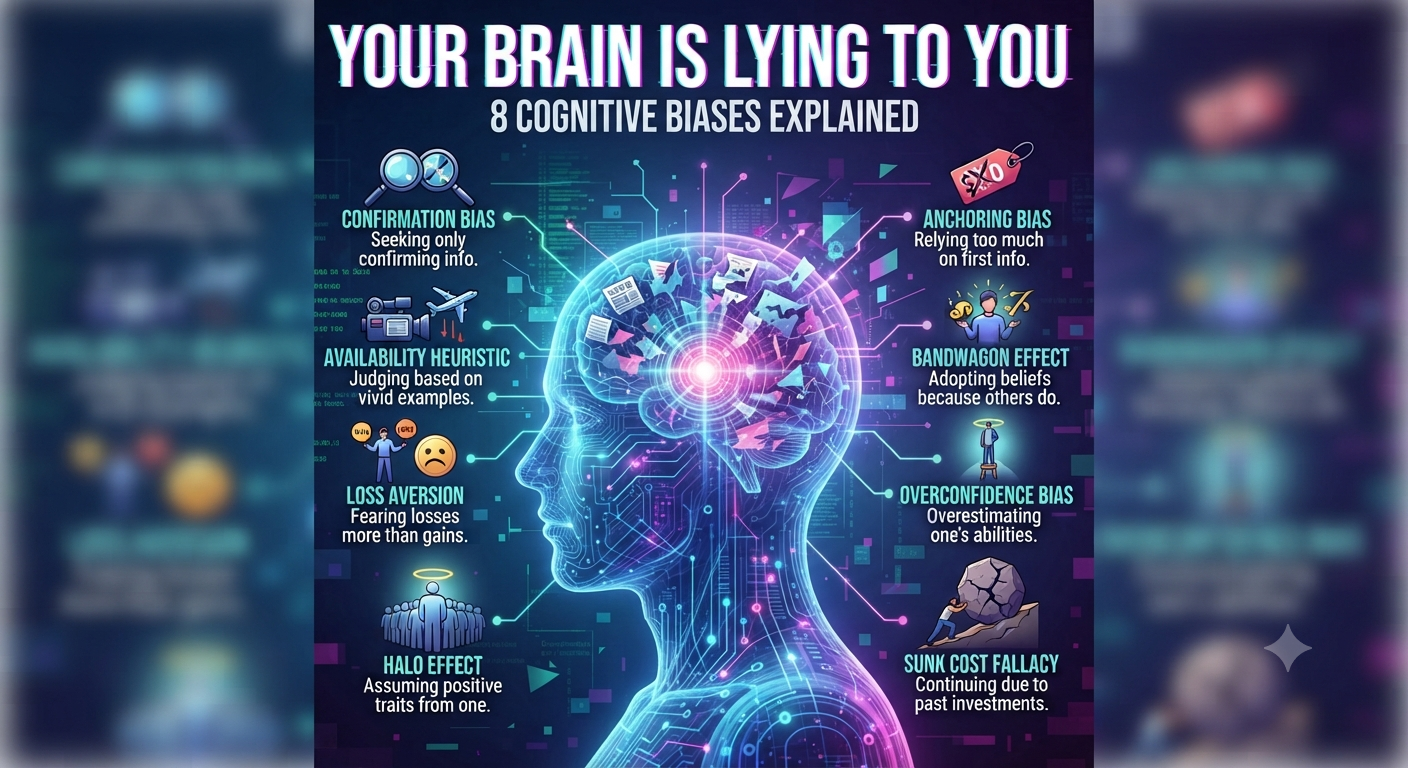
Are you really in charge of what you do? Let’s be honest. We all like to think we call the shots. But think back to your last trip to the store. Maybe you just went in to browse, and next thing you know, you’re hauling out a new pair of shoes and a smartwatch, convinced you scored a fantastic deal you never meant to chase. Or maybe you found yourself arguing so fiercely for your opinion that you ignored facts telling you you were wrong. Maybe you stuck around in a job or relationship that wasn’t right, just because you’d already put in too much time.
We call these choices our own. But are they?
What if the decisions you take pride in were actually shaped by hidden forces you barely notice? Surprise: They are. That’s the wild world of cognitive biases built-in quirks in the way your brain works. They don’t mean you’re not smart. These biases sneak up on Nobel Prize winners, doctors, CEOs, and just about everyone else. Why? Your brain is a machine built for shortcuts. It deals with millions of bits of info every second, but you only get to focus on a tiny slice. So your mind cheats, leaning on quick rules to help you out.
Usually, these shortcuts save you time and stress. Problem is, sometimes they trick you. Reality gets bent, your emotions go for a ride, and your choices drift off course. You don’t really get a say.
But if you get what’s happening behind the scenes, you can fight back. You make better decisions in work, money, love, whatever. So let’s pull back the curtain on the eight cognitive biases that steer you without permission.
1. Confirmation Bias
You don’t hunt for the truth. You hunt for agreement.
Ever type something into Google just to back up what you already believe? Yup confirmation bias in action. Your mind wants to find proof that supports your opinions, not stuff that threatens them. Say you’re convinced cryptocurrency is the future. Suddenly, every YouTube video, every tweet seems to agree with you. Warnings? You ignore them. Without meaning to, you end up living in an echo chamber.
Why? Changing your mind is hard work. It’s uncomfortable. So your brain favors certainty over the unknown.
How do you beat it? Seek out opinions that challenge yours. Ask yourself: “What would prove me wrong?” And spend time with people who poke holes in your thinking, not just those who nod along. Strong minds don’t run from new information they change.
2. Anchoring Bias
The first number you see sticks in your head.
Luxury brands know exactly how to use this. You see a watch for ₹1,00,000. Next to it, one for ₹35,000. Suddenly, ₹35,000 feels... reasonable even though nothing about that second watch changed. Your brain just found a new anchor. It works the same way whether you’re haggling over salaries, buying a house, investing, or just shopping online. That first number you see becomes the yardstick for everything else.
How do you fight it? Don’t trust the first figure you’re given. Shop around. Do your research before you negotiate. That first number? It’s almost always there to steer, not inform you.
3. Availability Bias
If it’s easy to remember, you think it happens all the time.
You watch the news: Airplane crash. Next flight, your palms sweat. Yet driving home? No big deal. Statistically, it makes no sense driving’s riskier. The problem? Our brains get hung up on vivid stories and dramatic headlines, so rare stuff suddenly feels common.
Want to beat it? Stop relying on your memory for how the world works. Check the facts. The numbers usually know better.
4. Loss Aversion
Losing hurts twice as much as winning feels good.
Picture this: You can take ₹10,000, guaranteed or flip a coin for a shot at ₹20,000, or nothing. Logically, both options work out about the same over time, but most people grab the sure thing. Why? Because losing stings a lot. That’s why investors keep holding onto bad stocks, entrepreneurs double down on doomed businesses, and people stay too long in unhappy relationships.
What’s the trick to getting over it? Ask: “Am I sticking with this because it’s best, or because I’m afraid to let go?” Letting fear call the shots almost never ends well.
5. Halo Effect
First impressions color everything.
She’s charming. He’s well-dressed. That manager sounds confident. Your brain draws lines: They must also be smart, trustworthy, capable. That’s the halo effect. It’s why celebrities pitch products they don’t use, and why first impressions are hard to shake.
Cut through it by separating image from facts. Just because someone seems impressive doesn’t mean they can deliver.
6. Bandwagon Effect
If everyone believes it, you start to wonder if it’s true.
Markets bubble and burst because people can’t resist joining in. Rumors fly because everyone keeps sharing them. We evolved to stick with the group it used to keep us alive. These days, following the crowd often leads us astray.
Next time you’re about to join in just because everyone else is: Stop. Ask, “Would I still believe this if I was the only one?” Truth doesn’t get more true with more followers.
7. Overconfidence Bias
The less you know, the more sure you feel.
Funny thing about knowledge the less people have, the more they think they know. True experts admit how much they still have to learn. Overconfidence blows up businesses, drains investments, and leaves people unprepared for risks they never saw coming.
A better approach? Stay curious. Don’t be afraid to ask questions, and let people critique your ideas. Earn confidence by doing the work, not just believing you’re right.
8. Sunk Cost Fallacy
Don’t let your past dictate your future.
You’ve poured three years (and a pile of cash) into a failing project. Logic screams “walk away.” But your heart says, “I can’t leave now I’ve already spent so much.” So you stick it out. Not because it makes sense, but because giving up feels like a loss you can’t swallow.
Truth is, the past is gone. Time and money spent aren’t coming back. Only your next decision matters. So ask yourself: “If I were starting fresh, would I do this again?” If your answer is no, it’s time to move on.
What’s the Real Takeaway?
All these biases show one thing: Your brain craves comfort and quick answers, not perfection. It isn’t a design flaw it’s survival. But the modern world is a carnival of information, ads, and clever nudges. Automatically trusting your first instinct doesn’t cut it anymore.
People who make better choices aren’t always the brainiest they just know when to pause, question, and double-check before acting.
Final Thoughts: Your Toughest Battle Is With Yourself
Most people try to make sense of the outside world. But the trickiest thing you’ll ever figure out is your own mind. Your brain is amazing but it’s also a master of self-deception.
If you get to know your biases, you gain something huge: a moment’s pause between impulse and action. And sometimes, that pause is the only difference between regret and relief.
Smartest move you can make? Don’t always trust your very first thought. Give it a good, hard look. That’s where real wisdom starts.
Discussion (0)
Leave a Reply
No confirmed discussions contributed yet. Be the first to start the thread!