We're living in a strange, fascinating moment right now.
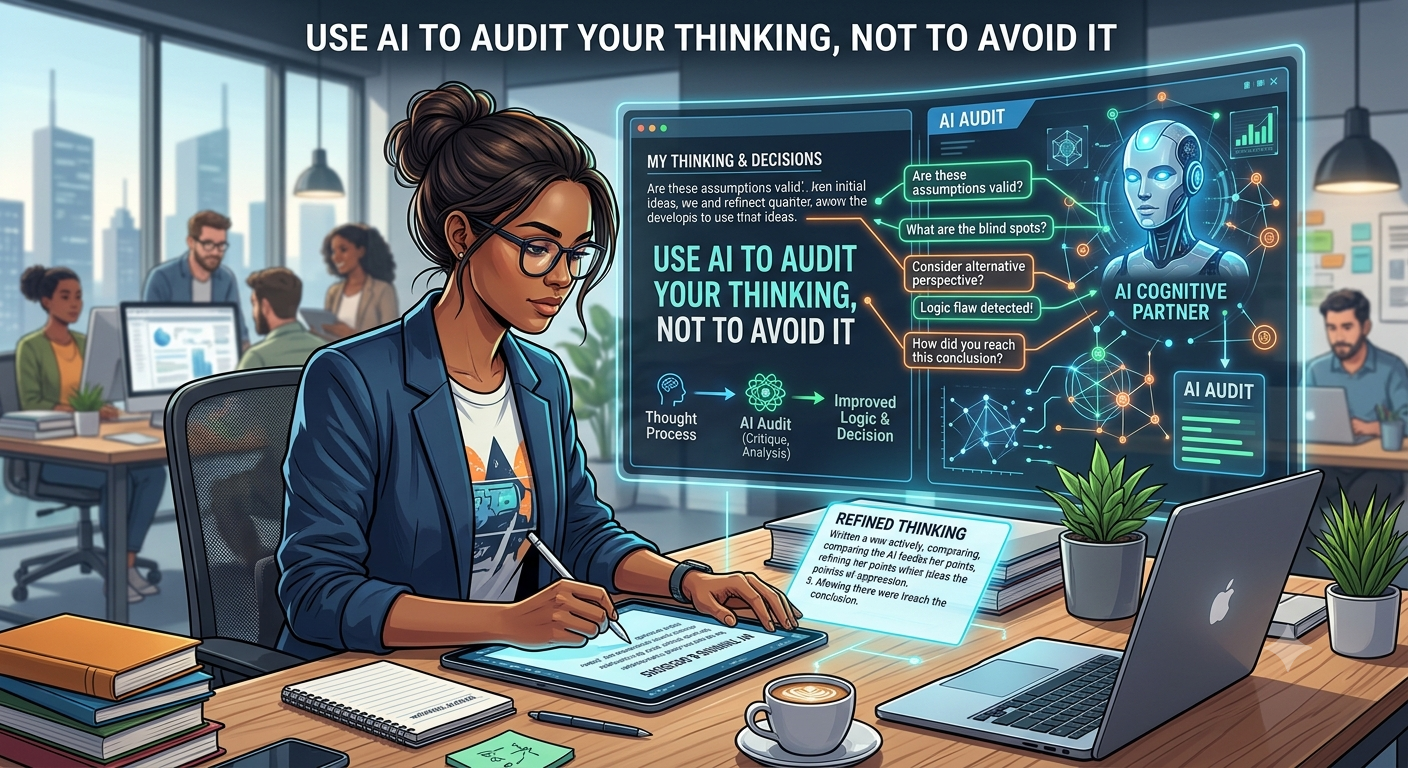
For the first time ever, we have tools that can check our decisions, call out our assumptions, dig into our strategies, and highlight what we’ve overlooked almost instantly.
That’s an incredible edge.
But it comes with a sneaky risk.
If AI does all our thinking for us, will we still know how to think for ourselves?
It depends on how we use it.
The smartest use of AI isn’t just letting it decide for us. The real power is in letting it review and sharpen the decisions we make.
The Brain Loves Shortcuts
Our brains are designed to save energy.
We look for shortcuts. Whenever we run into something familiar, we skip the analysis. We lean on experience, patterns, habits, gut feelings, and old solutions.
That’s not a bad thing. Think about how exhausting it’d be to consciously think through every little thing you do all day.
So, the brain automates whatever it can.
But not every mental task should be done on autopilot.
Some kinds of thinking are worth the effort precisely because they’re challenging.
Thinking Is a Skill Train It Like One
This goes a lot like exercise.
Push your muscles a bit, and they get stronger. The aim isn’t to make everything effortless. It’s to handle more.
Same with thinking.
Work through hard problems, make choices, challenge your own ideas, build arguments, and wrestle with uncertainty you get better at all of it.
With practice, some thinking speeds up and feels more natural. Your brain gets more efficient, not because you avoided the work, but because you trained it.
There is a huge difference between:
“This is easy because I’ve built the skill,”
and
“I don’t need the skill because a machine handles it for me.”
AI makes that second option tempting.
Here’s Where AI Changes the Game
Back in the day, dodging hard thinking usually meant you just skipped the hard thing entirely.
But now? AI wipes out most of the friction. You can ask:
- “What’s the best strategy?”
- “What should I do?”
- “Which option is right?”
- “Just write this plan for me.”
And in seconds, you get a pretty solid answer.
Sounds like you’re getting a lot done. And sometimes, you are. But sometimes you’re just handing the thinking over to the machine.
Yes, the task gets easier but are you getting better?
That’s the key distinction.
There’s a Smarter Way to Use AI
Let’s say you’re facing a big decision at work.
Don’t jump straight to, “Hey AI, what should I do?”
Think first.
Write down your decision. Lay out your reasoning. Spell out your assumptions. List the options you considered.
Then hand that thinking to AI and ask:
“Audit my reasoning. What assumptions am I missing? What could make this a bad call? What alternatives should I look at?”
Now things get interesting. AI isn’t doing your thinking for you it’s stress-testing it. That’s where real learning happens.
Make AI Your Cognitive Sparring Partner
A good sparring partner doesn’t just nod along. They push you. Point out weaknesses. Make you adapt.
AI can do this work intellectually:
- If you’ve got a strategy, ask AI to tear it apart.
- If you’ve got a conclusion, let AI argue the other side.
- If you’re sure about something, ask AI what could prove you wrong.
- If you think you've nailed the problem, check what AI thinks someone more knowledgeable might challenge you on.
Now, AI isn’t just an answer machine. It’s a thinking partner.
Don’t Outsource the Skills You Want to Keep
This rule goes way beyond AI.
If a task is boring, robotic, or doesn’t help you grow, automate it. But when the effort builds skill, don’t rush to ditch the hard work.
Let AI summarize, sure. But make sure you understand the key ideas. Let it offer strategies, but you make the call. AI can flag risks, but you weigh what matters. Let it question your judgment but you own the final say.
It’s not about rejecting convenience. It’s about knowing the difference between pointless effort and valuable effort.
Sometimes, Doing the Work Is the Training
We forget this a lot.
If your only goal is to get an answer, speed makes sense. But if your goal is to become someone who reliably finds good answers, the process matters.
A student who always looks up the solution finishes faster. But the one who grinds through mistakes, figures things out, and finally gets it, ends up better off long-term.
Same logic applies at work. Sometimes, the hard thinking isn’t blocking the finish line it’s building the person who crosses it.
AI Is Leverage, Not Replacement
The best at using AI aren’t just offloading everything. They know where AI gives them leverage.
Let AI tackle the volume. Let it handle repetitive stuff. Let it process mountains of data. Let it come up with wild ideas. Let it be your devil’s advocate.
And then you use your judgment to decide what really matters.
This combo is hard to beat: Human judgment plus machine intelligence.
You don’t have to choose one or the other.
Think First, Then Ask AI
Here’s a simple habit that works:
Think first. Before you ask AI for help, take a few minutes and form your own opinion. Ask yourself:
- What do I think?
- Why do I think it?
- What am I assuming?
- Where am I unsure?
Then have AI poke holes in your thinking.
You end up with a feedback loop:
Think → Ask → Get challenged → Learn → Improve → Repeat.
Over time, your questions get sharper. Your decisions get better. And eventually, your thinking gets stronger and quicker.
It’s Not About “Thinking More”
This is subtle.
It’s not about shunning AI or purposely making things harder. Don’t spend an hour on something AI can wrap up in thirty seconds. That’s not intelligence.
The point isn’t “more thinking.” It’s better thinking.
- Know when to automate.
- Know when to delegate.
- Know when to use AI.
- And know when you should flex your own mental muscles.
That judgment that’s a skill in itself.
Ask Yourself One Thing
Before you hand off a hard task to AI, ask:
“Am I trimming busywork, or am I skipping a chance to grow?”
If you’re just removing busywork, let AI do it. But if you’re ducking out on real skill-building, do it yourself then use AI to make your thinking sharper.
It’s Not Humans vs. AI
The best results won’t come from picking sides. They’ll come from blending strengths.
- AI’s great at handling data. Humans bring context, judgment, values, and responsibility.
- AI points out flaws in reasoning. You decide if the critique holds up.
- AI shows you possibilities. You choose which ones deserve action.
- AI makes you faster. You decide when speed actually matters.
That’s real augmentation.
Final Thought
Let AI make your life more efficient absolutely.
But pay attention to what you’re cutting. Some friction is useless. Get rid of it. But some effort? That’s where the growth happens.
Some thinking is a chore. Some thinking is training.
Let AI clear out the busywork. Let it audit your decisions. Let it challenge you. Let it catch what you’re missing. Just don’t let it do all the thinking for you.
Because real advantage isn’t just having access to a powerful tool. It’s building a sharper mind that knows how to use it.
Use AI to think better not to sidestep thinking altogether.
Discussion (0)
Leave a Reply
No confirmed discussions contributed yet. Be the first to start the thread!