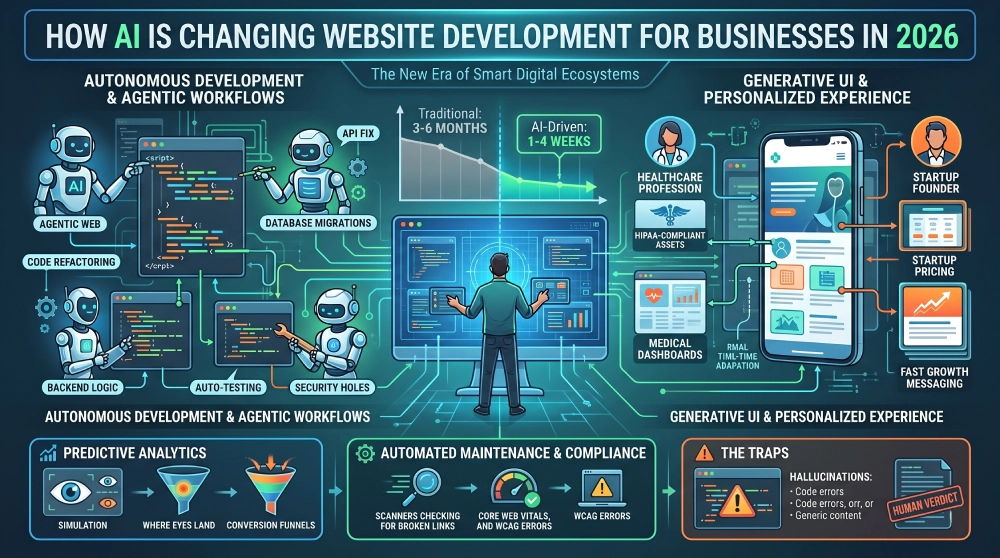
The Era of “Digital Brochures” Is Over
For a long time, most business websites were just static pages a nice homepage, an about section, some info about services, and a contact form. Sure, they looked professional, but they didn’t really do anything for businesses beyond sitting pretty online.
By 2026, that approach is dead.
AI isn’t just cranking out basic content or running simple bots anymore. Right now, it’s the backbone of modern websites. Companies aren’t asking, “Can AI make my site?” They’re asking, “How can AI automate what we do, help visitors convert, and fuel our growth?”
This shifts how web developers work. They're no longer just code jockeys they’re becoming digital architects, workflow strategists, and experts at connecting AI systems.
The companies coming out on top aren’t showing off the slickest designs. They’re building smart digital ecosystems. Their websites run on automation, adapt to each user, crunch predictive analytics, and manage workflows with AI.
1. The Agentic Web & Autonomous Development
One of the biggest changes in web development? The rise of what’s now called the Agentic Web.
In the past, AI tools could spit out bits of code or answer programming questions. Today’s AI agents are like tireless assistants handling all kinds of complex tasks almost no human babysitting required.
Developers are jumping into advanced AI environments like:
- Cursor
- Windsurf
- Devin-like coding agents
- Multi-agent systems
- DevOps with heavy AI support
Now, these tools can build UI elements on their own, handle complex database migrations, follow backend logic, fix APIs, streamline code structure, write documentation, find security holes, and test apps automatically.
What This Means for Businesses
Used to be, if you needed a custom dashboard or quotation system, you’d wait months. Now, AI-powered workflows cut that down sometimes slashing development time by 50% to 70%. So a business can spin up custom CRMs, internal platforms, AI quotation tools, workflow automation, SaaS integrations, and employee management systems in days, not months.
Old vs. New
- Traditional: 3–6 months to deliver, big teams, lots of manual coding, slow debugging.
- AI-Driven: 1–4 weeks to deploy, small AI-backed teams, automated workflows, AI catches errors fast.
Developers aren't going anywhere. Their job just got way more powerful.
2. Generative UI & Hyper-Personalized Experiences
Static websites are basically extinct. Websites in 2026 change on the fly. They react to where you’re from, what device you’re using, what industry you’re in, and what you want. That’s Generative UI.
Instead of showing everyone the same homepage, AI pulls together layouts and content that feel custom-made right as you arrive.
Industry Examples:
- SaaS (Healthcare vs. Startup): If you’re from healthcare, you'll see case studies in healthcare, examples of HIPAA-compliant assets, and medical dashboards. If you're a startup founder, you’ll get startup pricing, messaging about fast growth, and solutions for funding.
- E-commerce: AI acts like a savvy sales assistant providing personal product picks, custom landing pages, bundled deals generated on the fly, smart discounts, and chatbots for buying help.
Hyper-personalized websites get serious results: more conversions, better retention, higher engagement, bigger average orders, and stronger leads. Businesses aren’t building websites anymore. They’re setting up smart, adaptive sales machines.
3. Predictive Analytics & Pre-Launch Optimization
Old web design was mostly guesswork. Launch the site, then stare at analytics, hoping to figure out what’s wrong. AI flips that on its head by simulating thousands of user sessions before anybody even sees the live site.
What AI predicts before launch:
- Where users’ eyes go and how far people scroll
- What CTAs grab attention and how likely visitors are to bounce
- Where conversions jam up and problems with mobile navigation
- Spots where people drop out of the funnel
No more asking “Why are visitors leaving?” Instead, it’s “How can we boost conversions before we’re live?” This leads to faster ROI, better leads, more sales, and less wasted ad money.
4. Automated Maintenance, Security & Accessibility
Website upkeep has always been a pain: clashing plugins, security holes, compliance checks, slow load times, and broken integrations. But AI maintenance agents are making that nightmare go away.
AI now automatically finds security gaps, boosts page speed, monitors Core Web Vitals, fixes accessibility issues, scans for broken links, audits SEO, optimizes images, and refactors clunky code. These systems running in secure, sandboxed environments can fix up to 70% of accessibility issues without human help.
For businesses, this translates to cheaper maintenance, quicker sites, better search rankings, stronger compliance, less downtime, and improved mobile performance.
5. The Tough Truth About 100% AI-Generated Sites
With all the hype, some businesses dive straight into using only AI for site creation. But honestly, that's risky.
- Mistake #1: AI Hallucinations: AI can generate code that looks fine but hides nasty surprises like security weaknesses, database messes, broken logins, SEO issues, and massive performance slowdowns.
- Mistake #2: Generic Template Sites: AI sites can look polished but totally boring. They easily miss unique brand personality, good storytelling, strategic user experience, and the psychological nuance that drives conversions.
- Mistake #3: SEO & Compliance Problems: Badly structured AI sites can break rules for search engines, accessibility, and user privacy laws.
Human experts still matter deeply for technical SEO, planning structural site data, security tuning, and brand positioning. AI’s powerful, but it’s no substitute for core strategy.
The Future for Web Developers
Developers aren’t vanishing they’re adapting. By 2026, the best developers are architects of AI-driven workflows, automation pros, experts at system integration, and conversion optimization engineers. Coding itself is becoming a commodity; strategic thinking is where the real value lives.
Quick Reference Table for Businesses
| Traditional | AI-Driven (2026) | Business Benefit |
|---|---|---|
| Manual coding | AI automates code | Faster projects |
| Static homepage | Personalized UI | Better conversions |
| Manual A/B test | Predictive optimization | Higher ROI |
| Multiple tools | Custom AI systems | Save on software |
| Reactive fixes | AI monitoring | Less downtime |
| Basic support | Conversational AI | More engaged customers |
Final Thoughts
AI isn’t replacing website development it’s reinventing it. The real edge in 2026 isn’t about building sites fast. It’s about building smart workflows, tailored customer journeys, automated internal systems, and conversion-focused scalable digital platforms.
If you treat AI as a shortcut for copying templates, you’ll fall behind. Use AI wisely to automate, personalize, and drive real business results, and your business will lead. The future belongs to businesses running smart digital ecosystems.
Bonus: Master Prompt to Build One-Page Business Websites
You can copy and run this advanced prompt in ChatGPT or Gemini to jumpstart your development stack:
Act as a senior UI/UX designer, conversion strategist, SEO expert, and full-stack web developer.
Create a modern, high-converting one-page business website for [BUSINESS TYPE].

Website Goal:
- Generate leads
- Increase trust
- Improve conversions
- Mobile-first responsive design
- Fast loading speed
- SEO optimized

Business Details:
- Business Name: [BUSINESS NAME]
- Services: [SERVICES]
- Target Audience: [TARGET AUDIENCE]
- Brand Style: [MODERN / LUXURY / CORPORATE / CREATIVE / TECH]
- Primary Color Palette: [COLORS]
- CTA Goal: [CALL / WHATSAPP / BOOKING / FORM SUBMISSION]

Required Sections:
1. Hero Section with strong headline and CTA
2. About Company
3. Services Grid
4. Why Choose Us
5. Portfolio / Case Studies
6. Testimonials
7. Process Timeline
8. FAQ Section
9. Contact Form
10. Footer with social links

Advanced Requirements:
- Add smooth animations, sticky navigation, and scroll effects
- Modern typography and SEO-friendly heading structure
- Schema-ready structure and optimized Core Web Vitals
- Highly responsive layout with trust badges and statistics placement

Tech Stack:
- HTML5
- Tailwind CSS or Bootstrap 5
- JavaScript
- Optional Laravel integration structure

Design Style:
Create a premium UI similar to modern SaaS and startup websites in 2026.

Output Requirements:
Provide complete production-ready code. Keep code clean, modular, and well-commented with attractive UI/UX spacing. Include an AI chatbot interface concept and a lead capture popup logic.
Discussion (0)
Leave a Reply
No confirmed discussions contributed yet. Be the first to start the thread!